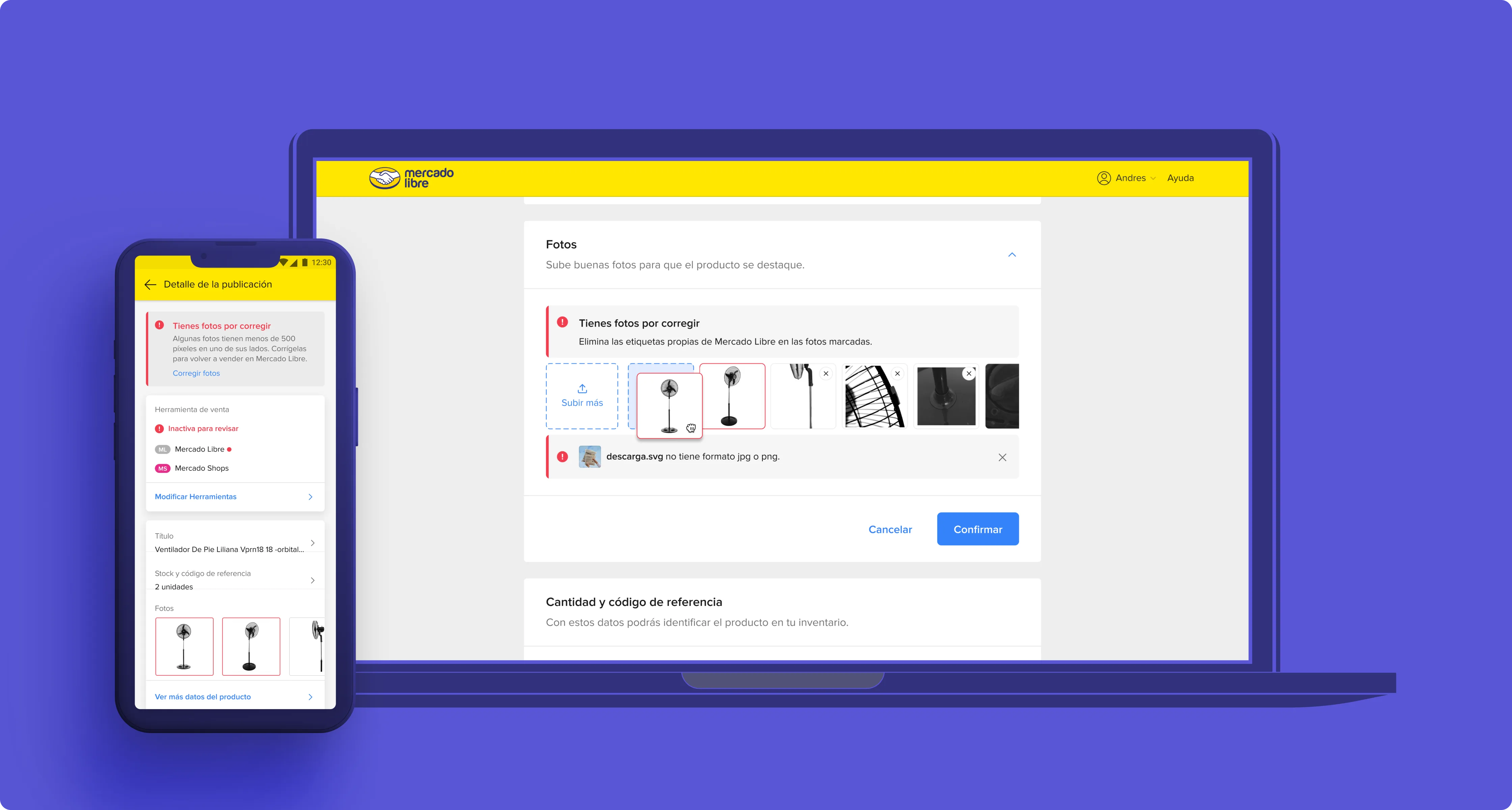
I designed the preview-first interaction model for Mercado Libre’s AI Photo Studio, so sellers could inspect, compare and reverse edits before committing.
Detecting a bad photo did not solve the seller’s task.
Moderation could identify photo-policy issues, but sellers still needed to correct them. That journey often left the platform and depended on external editing tools. An AI editor could close the gap, provided people trusted what it would change.
Product images represent the seller’s work and directly influence the listing. Applying an AI result without a clear preview could turn a faster workflow into a loss of control over the product being sold.
T / TASK & OWNERSHIP
Make the AI’s proposal understandable and reversible.
I set the UX direction for the trust model, entry points and editor states, collaborating with Product, Engineering and ML. My scope covered the interaction and handoff. The team launched the product after my departure, with the preview-first model retained.
A / ACTIONS & DESIGN DECISIONS
Put a human checkpoint between generation and commitment.
The interaction contract
01
Preview
The AI proposes a correction.
02
Compare
The seller evaluates before and after.
03
Choose
Confirm the change or return to the original.
01
Risk-led exploration
Explore failure before polishing the happy path.
I stress-tested more than 40 edge cases with AI-assisted scenario exploration before committing to the interaction direction: a background cut into the product, an incorrect correction or an interrupted process. The purpose was to expose risks early; this was design exploration, not a substitute for usability testing.
02
Interaction & trust
Separate the AI output from the user’s decision.
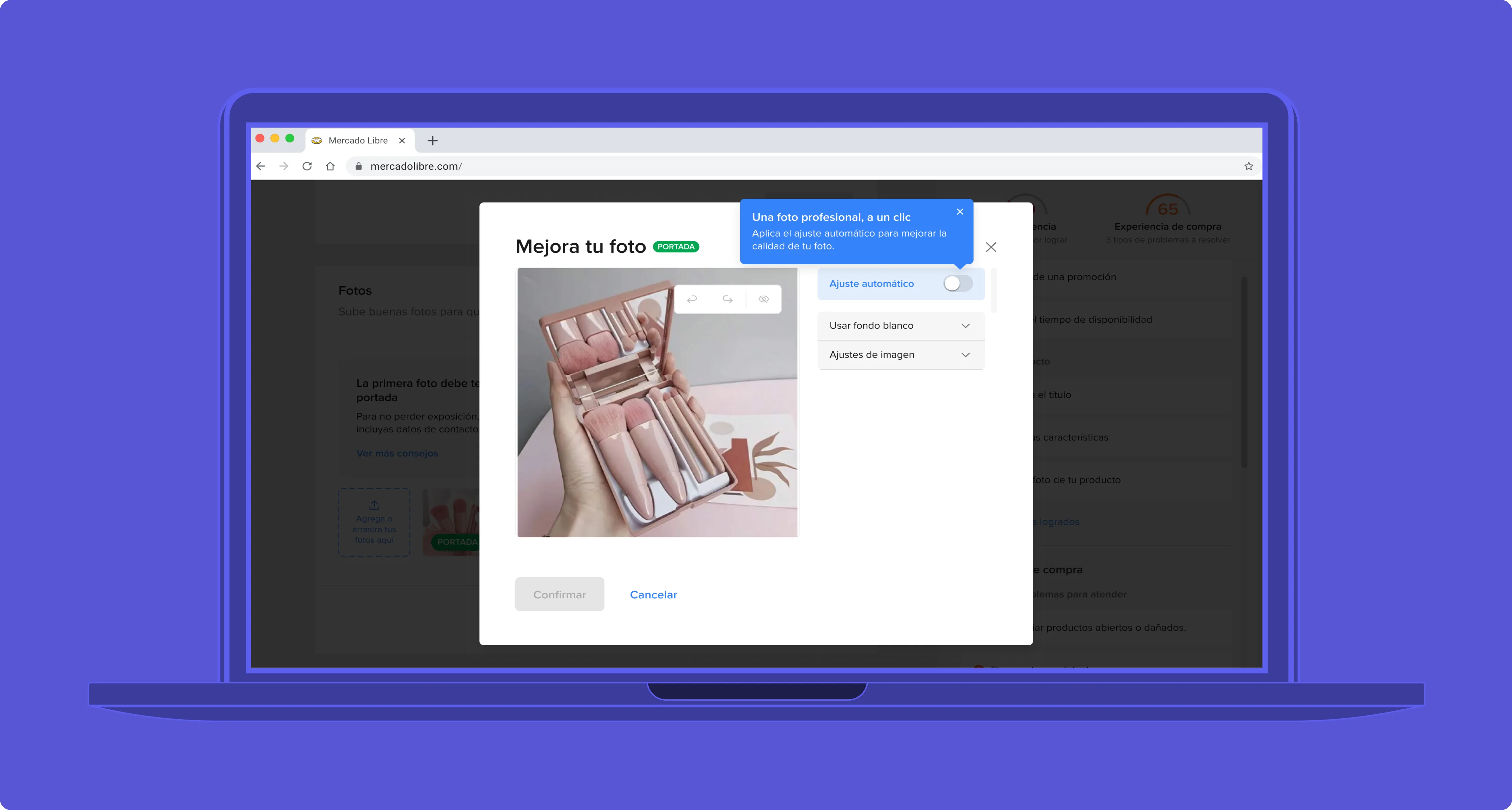
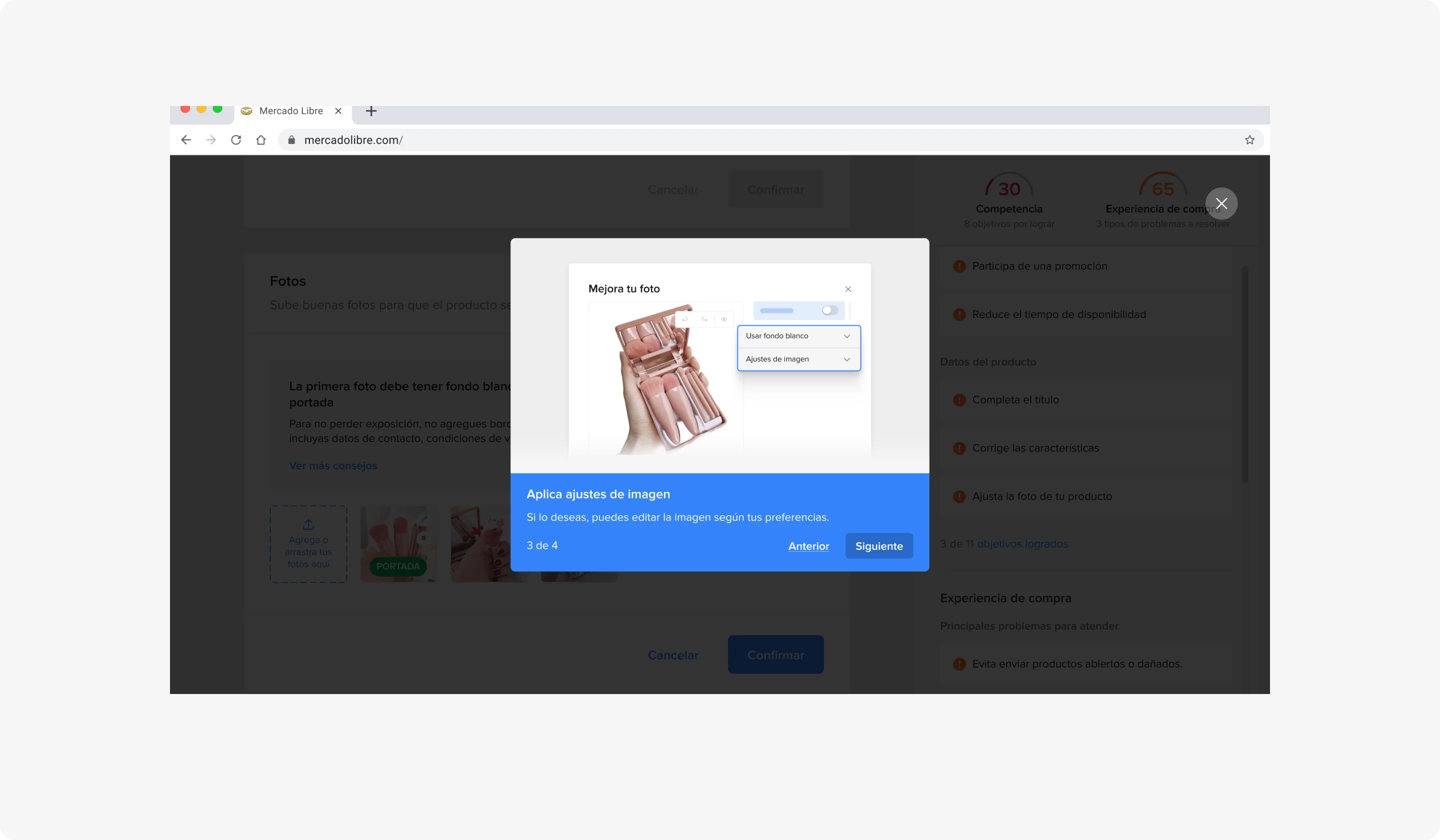
The editor presents a before/after comparison before anything is applied. Sellers can inspect the proposal, confirm it or return to the original. I treated reversibility as part of the core interaction, because control had to be visible at the moment people evaluated the edit.
03
Scope & implementation
Solve a specific correction task.
I scoped the experience around background, resolution and prohibited text or logo issues, rather than a general-purpose editing suite. I documented the behavior of each state and preserved the same interaction logic across app and web, so the team could implement the model after the design handoff.
Photo Studio process and correction preview from the project documentation.
R / RESULTS & BUSINESS IMPACT
A trust model that made it into the shipped product.
70%
of sellers using the tool saw conversion improve
40+
edge cases explored before production design
3
correction capabilities within a shared flow
The team launched Photo Studio after my departure, preserving the preview-first interaction I handed off. The reported post-launch outcome was that 70% of sellers who used the tool improved their listing conversion. That figure describes the share of sellers who saw an improvement; it does not describe the size of a conversion lift.
70% is a reported share of participating sellers, not a 70% conversion uplift. Design and handoff were my scope; launch and commercial results were team outcomes.
What I learned
For AI that changes someone’s work, trust belongs in the interaction architecture. A visible comparison and a clear way back can matter more than removing one more step.
What I would explore next
I would evaluate how clearly different seller groups understand recovery, then test whether the same model holds for batch edits and more complex media.